
A leaking hose bib is easy to ignore. It sits outside, the drip lands on gravel or concrete, and the hose still works. But a drip with the handle off keeps going day and night, it stains the slab, and sometimes it’s the first sign of a worn valve or a cracked pipe. So let’s work out where the water is coming from, what you can safely check yourself, and when a repair beats a replacement.
Hose bibs are one of Geo’s everyday repairs, and he has been fixing them for more than 12 years, the last 3 in the Valley. Many of these leaks trace back to a few small rubber parts.
What causes a leaking hose bib
A hose bib (also called a spigot or outdoor faucet) is a simple valve. On a standard model, turning the handle presses a rubber washer on a stem against a brass seat. Some quarter-turn models use a ball or cartridge instead. Either way, where the water shows up tells you which part failed.
Drips from the spout with the handle off
Here, the stem washer has worn, hardened or cracked, so it no longer seals against the seat. Mineral scale can also leave a rough spot on the seat that the washer can’t cover. Often, a new washer fixes it. However, if the seat is pitted, the drip comes back fast, and a new bib makes more sense.
Water around the handle while it runs
If water seeps out under the handle only while the faucet is on, the packing around the stem is worn or the packing nut has loosened. As a result, water escapes along the stem instead of leaving through the spout.
Spray where the hose screws on
A spray at the hose connection usually means a missing or flattened rubber washer inside the hose coupling. That part belongs to the hose, not the faucet, so check it first. Stripped or dented threads on the bib are another cause, and those mean replacement.
A cracked hose bib body or pipe
Water from the faucet body, the threads behind it or the wall is more serious. A hard freeze can crack a faucet or the pipe feeding it, and older fittings corrode over time. If the pipe or joint behind the bib is the problem, a washer won’t help.
The shut-off valve right next to it
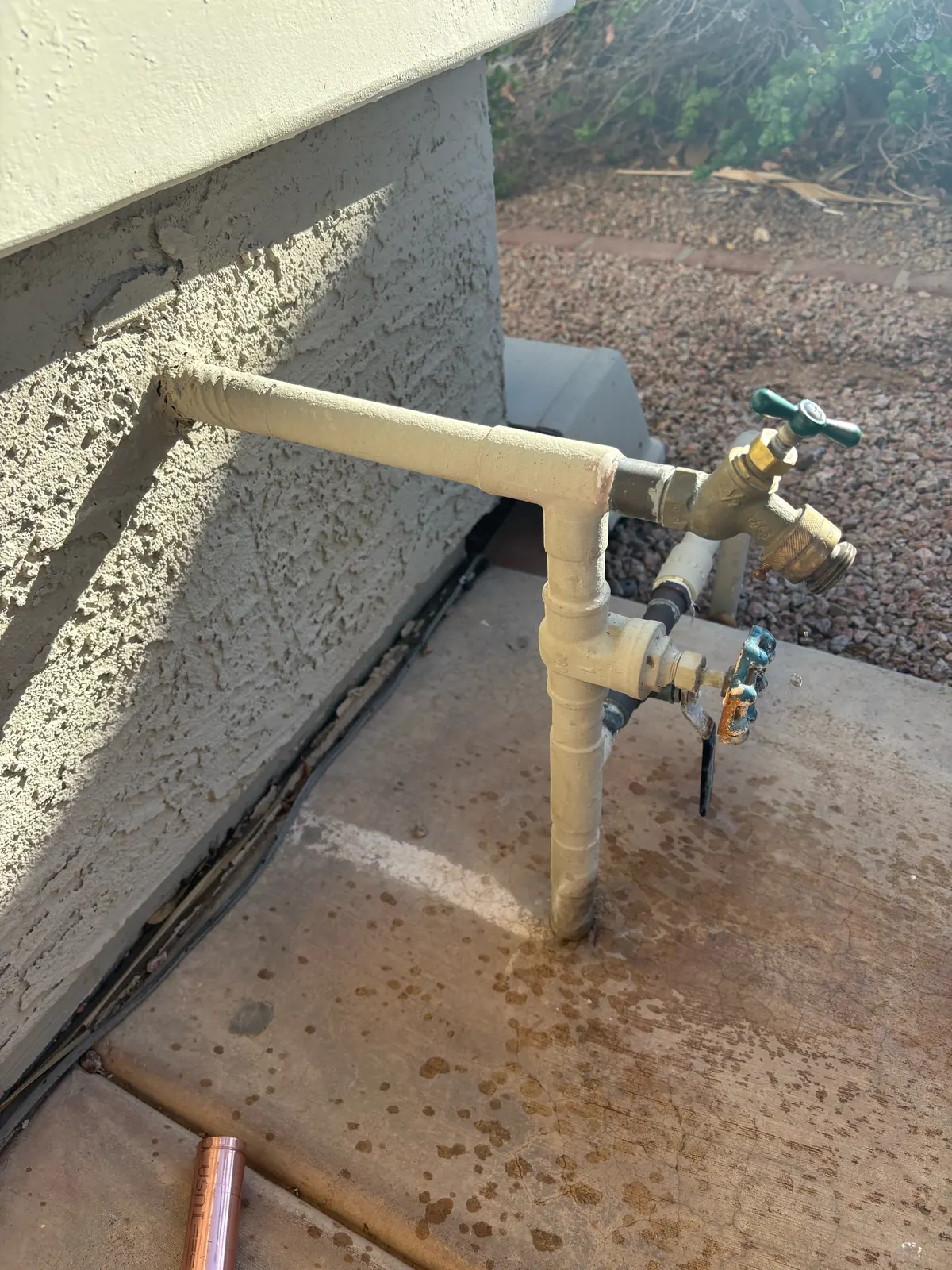
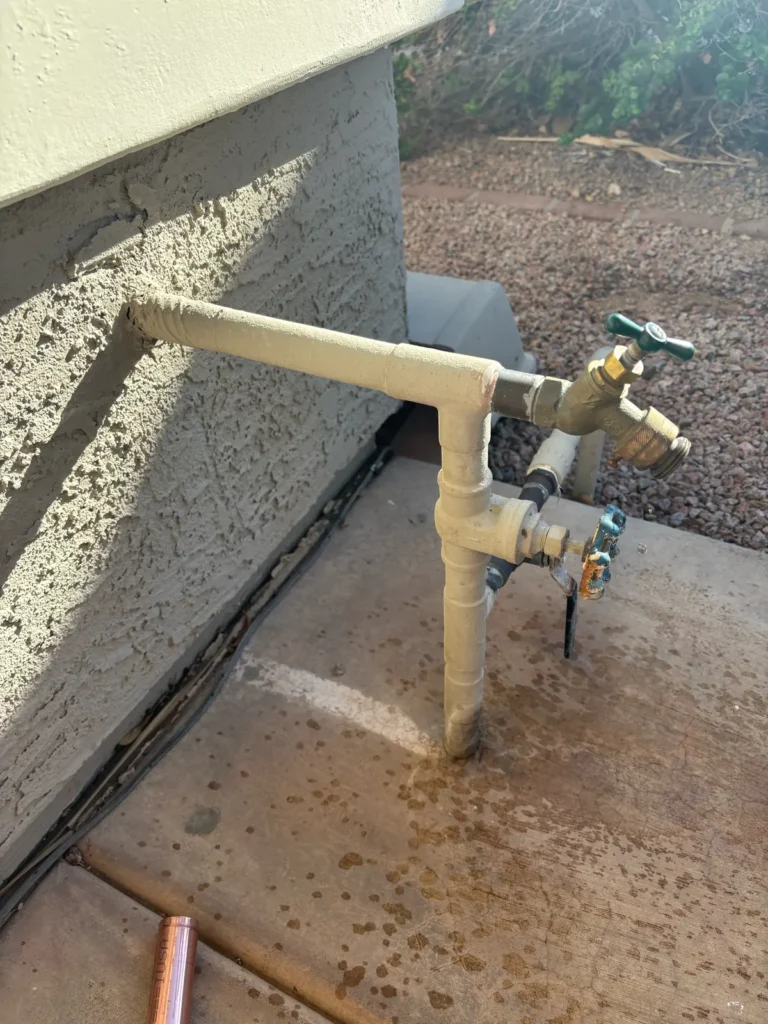
In most Phoenix homes, the main shut-off sits at the front of the house near a hose bib, according to the city’s household plumbing tips. So the drip you blame on the faucet might really be that valve, like the old wheel-handle gate valve in the photo above. Gate valves like that can weep at the stem or stop closing all the way, and you need yours working when a pipe breaks.
Quick checks you can do yourself
First, find your main shut-off and make sure it turns by hand. Don’t force a stuck one, since old valves can break. If you’ve never closed yours, this walkthrough on shutting off your water in an emergency shows where to look. Then try these checks, easiest first.
- Dry the faucet, remove the hose and watch for a few minutes with the handle off. Note where the first drop forms.
- Look inside the hose coupling. If the rubber washer is missing, flat or cracked, replace it and test again.
- If water seeps around the stem while the faucet runs, snug the packing nut under the handle about an eighth of a turn. Hold the faucet body steady with a second wrench so you don’t twist the pipe behind it.
- For a drip from the spout, shut off the water at the main valve and open the faucet to drain it. Next, unscrew the packing nut, pull the stem and swap the washer for one the same size. If the stem is seized, put the tools down and call for help.
- Finally, ease the water back on and recheck.
Whatever you do, don’t shut water off at the city meter. Phoenix says that takes a special tool, and you could be held responsible for meter damage. Also, leave any nearby gas line or electrical box alone. If the brass is crusty or the pipe wiggles in the wall, let a qualified plumber handle it.
Check your water meter for hidden leaks
Say you replace the washer, yet the water bill stays high. That’s when the meter check helps. Fix the drip first, though, or the meter will only show you the leak you already know about.
The AMWUA Smart Home Water Guide walks through it. First, turn off every fixture and appliance that uses water. Then rule out the quiet users, such as a pool auto-fill, an evaporative cooler, an ice maker, or a reverse osmosis system or softener that’s regenerating. Your meter usually sits in a concrete box near the curb or sidewalk, though some utilities lock the lids.
Look for the small low-flow indicator, which may be a triangle, a star or a gear. If it turns while everything is off, water is leaking somewhere. For slower leaks, write down the reading, wait 20 minutes without using any water, and read it again. Phoenix meters measure in cubic feet, so multiply the difference by 7.48 to get gallons.
Still moving? Close the house valve and any irrigation valve that bypasses it, then watch again. If the meter keeps going, the leak is likely in the buried line from the meter. If it stops, look past the valve, from toilets to sprinkler lines to pipes under the slab. Either way, if you can’t spot it, that’s when professional leak detection earns its keep.
Phoenix heat, scale and freezes on an outdoor hose bib
An outdoor faucet gets little shelter here. Months of sun bake the handle and any bare pipe behind it, and the city’s tip sheet flags exposed pipes as more likely to leak and break. Meanwhile, Phoenix’s 2025 Water Quality Report notes that hard water can cause scaling on faucets.
If scale keeps coming back, our Phoenix hard water guide explains what helps. The tip sheet also suggests insulating or relocating exposed pipes, and before a freeze warning it recommends these steps:
- Remove, drain and store your garden hoses.
- Close any inside valves that feed outdoor hose bibs. Then open the bibs, let them drain and leave them open.
- Keep the garage door closed if water lines run through the garage.
- Open kitchen and bathroom cabinet doors so warm air reaches the pipes.
- Let a faucet drip slightly.
If a pipe or faucet does freeze, never thaw it with an open flame or a torch. When nothing comes out of a faucet, the city says to leave it open and call a plumber. After a thaw, check the bib and its pipe for new drips.
Repair or replace a leaking hose bib?
Here’s how that usually plays out. Many drips are a washer or packing job, and the faucet itself is fine. Still, some aren’t worth saving.
- Repair it when the faucet body has no cracks, the threads are clean, the handle turns smoothly and new rubber stops the leak.
- Replace it if the brass has split, water comes from the threads or the wall, the hose threads are stripped, or the drip returns soon after a new washer.
- Upgrade the shut-off when the old gate valve nearby weeps or won’t close. A quarter-turn ball valve shuts with a 90 degree flip of the lever, and a lever across the pipe means closed.
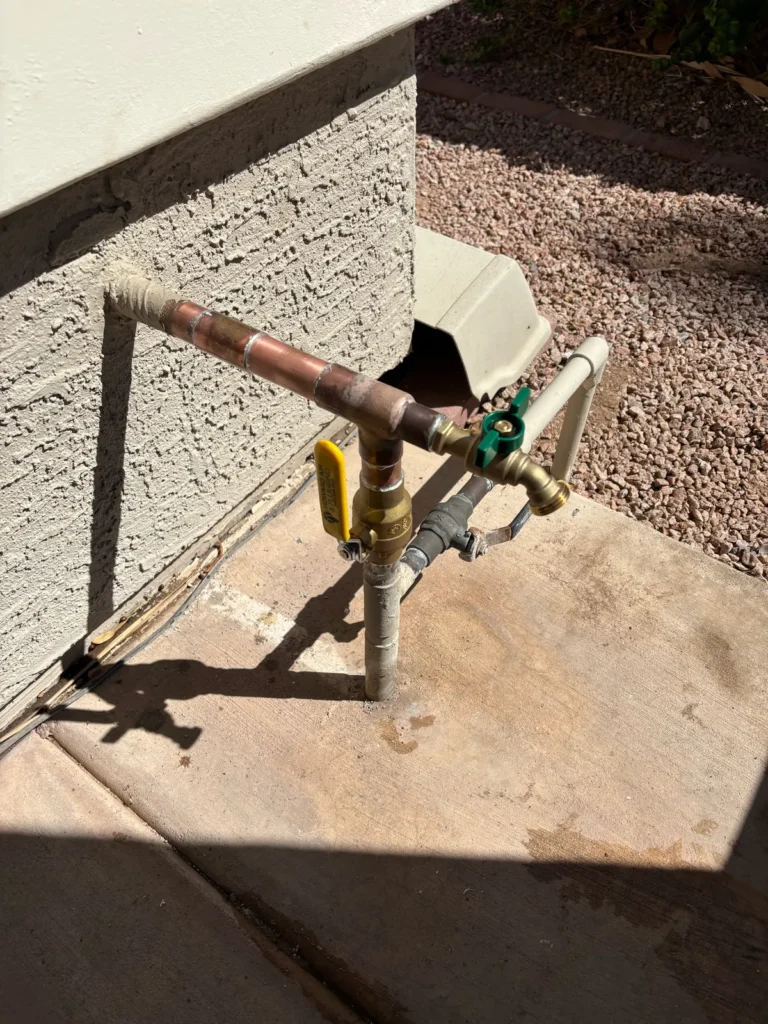
On the job in these photos, the old bib and the worn gate valve below it came out. New copper, a brass ball valve and a new hose bib went in. Swaps like this fall under our general plumbing repairs.
If the drip is coming from a separate backflow device near the front faucet, see our guide to irrigation backflow preventers instead.
Two common hose bib questions
Can I fix a leaking hose bib myself?
Often, yes. A hose washer, packing nut or stem washer is well within reach once the water is off. On the other hand, a seized stem, a loose pipe or a cracked body is work for a plumber.
Does a leaking hose bib raise my water bill?
It can. A drip with the handle off is water passing through your meter, so you pay for it. Once it’s fixed, the meter check above shows whether anything else is leaking.
Getting your outdoor faucet dry again
A slow drip outside is rarely an emergency, but it won’t fix itself either. Start with the hose washer, then run the meter check, and you’ll usually know whether it’s a small part or a bigger repair.
If you’d rather have Geo check the bib, the valve under it and the pipe in the wall, grab an open slot on the schedule page. You can also browse before and after photos from real jobs, including this one.