
Under most sinks and behind most toilets in your home sits a small angle stop valve. Most people never touch it until something goes wrong. That’s a problem, because a leaking supply line is a bad time to learn the handle won’t turn. Phoenix hard water can make a stuck valve more likely, too. A quick test now tells you whether each one will actually shut off. We’ll also cover the two main valve types and when a replacement makes sense.
Where an angle stop valve fits in your plumbing
Where a water pipe comes out of the wall under a sink, it ends at a small valve that turns the flow 90 degrees, up toward the faucet. That bend is where the “angle” in the name comes from. Then a flexible supply line carries water from the valve up to the fixture.
A bathroom sink usually has two stops, one for hot and one for cold. A toilet has a single cold stop, low on the wall or floor behind it. Under the kitchen sink, the hot stop may also feed the dishwasher through a valve with two outlets.
Each angle stop valve lets you shut off one fixture without cutting water to the whole house. That means you can swap a faucet or fix a running toilet while everyone else still has water. For bigger trouble, like a burst pipe in a wall, you still need the main valve. Our emergency shut-off guide walks through finding and closing it step by step.
Here’s where that matters. A toilet tank starts overflowing late on a Sunday night. If the stop behind it turns, you close it, mop up and deal with the toilet in the morning. If it won’t move, you’re out front looking for the main shut-off while water spreads across the floor.
Multi-turn versus quarter-turn stops
Start with the handle. A round, wheel-style handle usually means a multi-turn valve, while an oval or lever handle points to a quarter-turn valve.
Multi-turn stops
Inside a multi-turn stop, a threaded stem pushes a rubber washer down onto a seat. You turn the handle clockwise several times to close it. These were standard for decades. However, the washer hardens with age, and the stem threads collect minerals. Eventually the handle gets stiff, or the valve closes but still lets a trickle through.
Quarter-turn stops
A quarter-turn stop usually has a small ball inside with a hole through it. When you turn the handle 90 degrees, that hole swings sideways and blocks the flow. There’s no washer to squash, so it closes with one short, easy turn. Also, on many models the handle position shows at a glance whether the valve is open.
That said, quarter-turn stops aren’t magic. They can still stick if nobody turns them for years, and a cheap one can fail early. So if your old multi-turn stops open, close and stay dry, they can stay right where they are.
Why an old angle stop seizes in Phoenix hard water
Phoenix tap water is very hard, and the city’s 2025 Water Quality Report says hardness can leave scale in pipes and on faucets. The valves under your sinks sit in that same water every day.
An angle stop valve that sits wide open for years can slowly lock up in place. Here’s how that tends to happen:
- Mineral crust builds up on the stem until the handle won’t turn by hand.
- The rubber washer hardens with age and heat, so water slips past even when the valve is closed.
- When someone finally cranks on a stiff handle, the packing around the stem can start to weep.
- Chalky or green buildup grows wherever a slow drip keeps drying out.
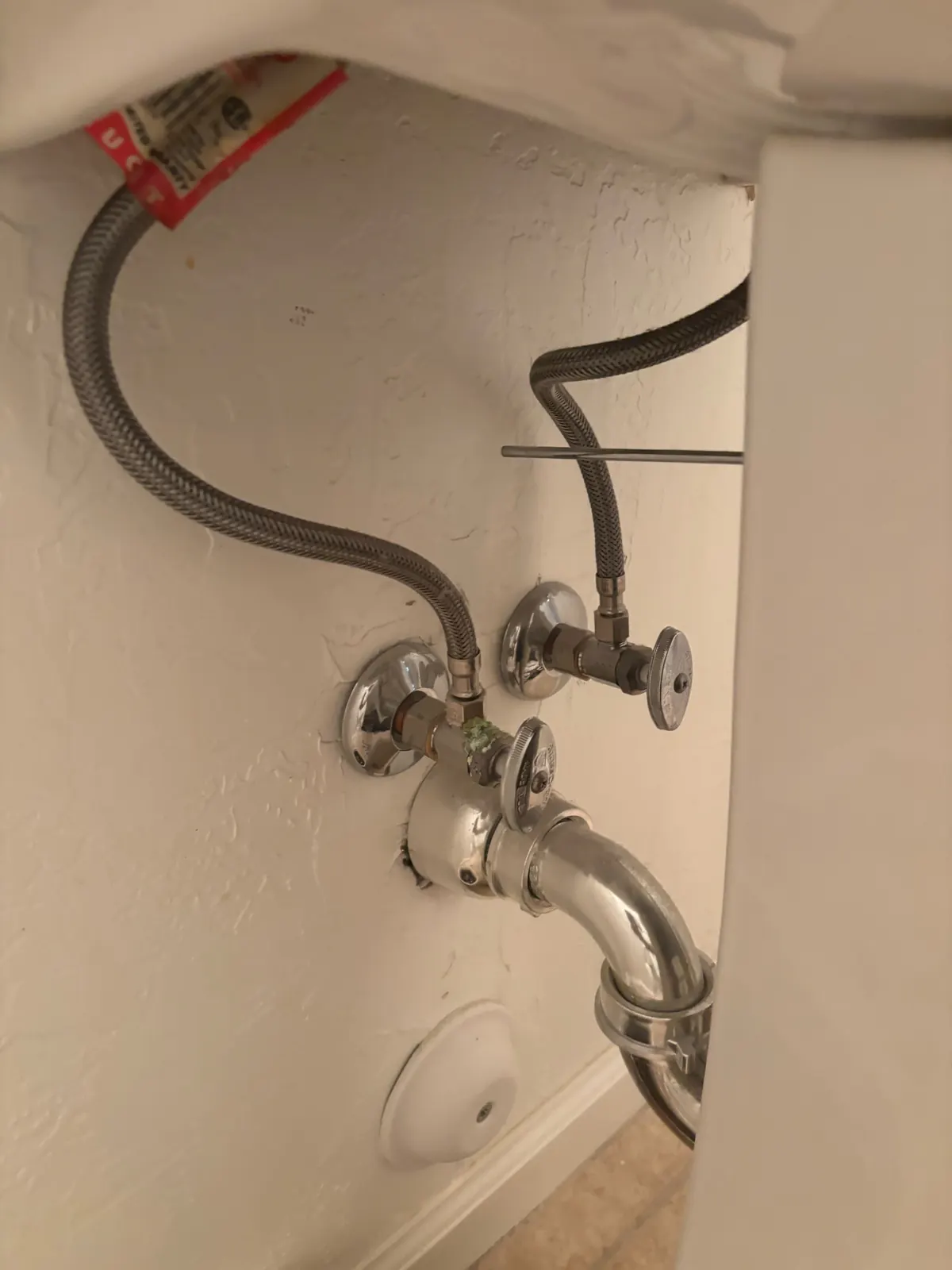
In Geo’s experience, the stops that cause trouble are the ones nobody has touched since the day they went in. The green crust on the left valve in the first photo is the kind of warning sign to look for. Our guide to Phoenix hard water explains how scale affects the rest of your plumbing.
How to test each angle stop before you need it
The City of Phoenix’s household plumbing tips say to know where your shut-off valve is and test it regularly. That advice is about the main valve, but the same habit pays off under your sinks. Once or twice a year is plenty, and a bathroom takes about five minutes.
- Empty the cabinet, then set a towel and a flashlight under the valves.
- Look for crusty buildup, rust on the supply line, or water stains on the cabinet floor.
- Turn one handle by hand until it stops: clockwise on a round handle, or a quarter turn on a lever. Never force it.
- Open that side of the faucet. If the flow slows to nothing, the valve seals, but a trickle that never stops means it doesn’t. For a toilet, flush and watch whether the tank refills.
- Next, turn the faucet off and open the valve all the way again.
- Finally, check back in an hour. A bead of water under the handle or a fresh wet spot below means the valve is weeping.
Renters can do this check too. However, report a stuck or dripping stop to your landlord rather than fixing it yourself.
If the handle won’t budge
Resist the urge to grab a wrench. Pliers or a wrench on a frozen handle can snap the stem or twist the pipe inside the wall. Instead, leave the valve open and plan a replacement. Until then, remember that the main shut-off is your backup for that fixture.
If it drips after you turn it
A slow weep from behind the handle usually comes from the packing nut, the small nut the stem passes through. Snugging it gently with a wrench, a little at a time, often stops the drip. Steady the valve body with your other hand so the pipe doesn’t twist. But if it keeps weeping, or the valve never closed fully, plan to replace it.
Replacing an angle stop valve and supply line
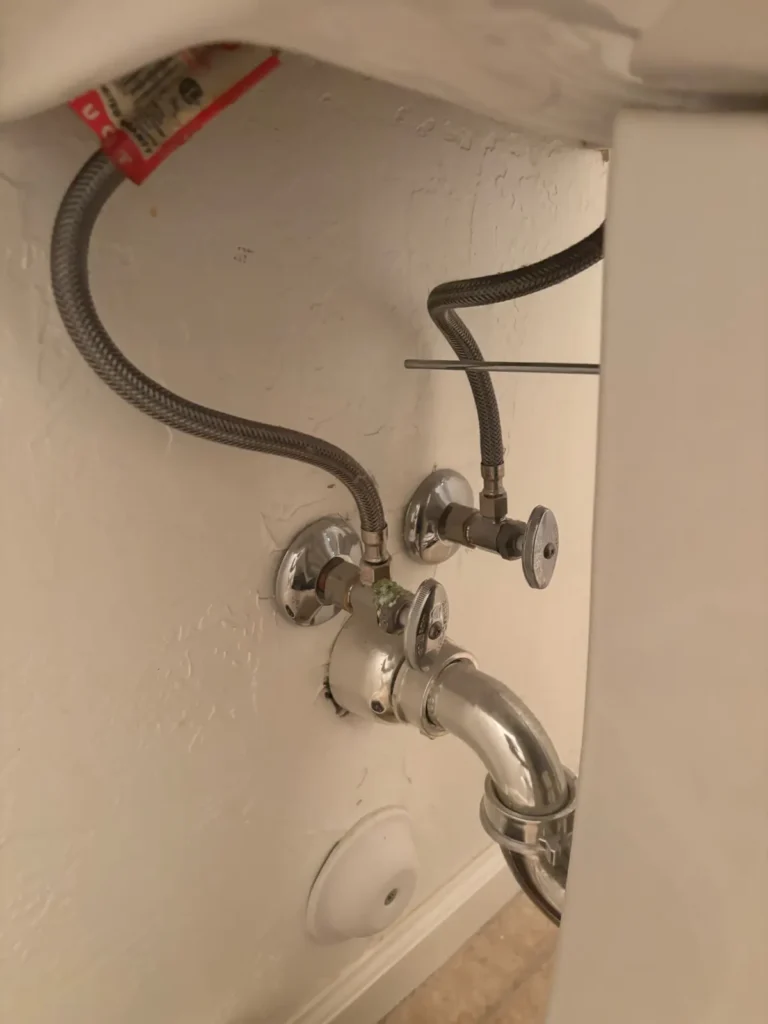
When an angle stop valve fails the test, replace its supply line at the same time. The water is already off, so a fresh line now saves a second job later. Our second photo shows that kind of swap: new quarter-turn stops and new braided lines under a bathroom sink.
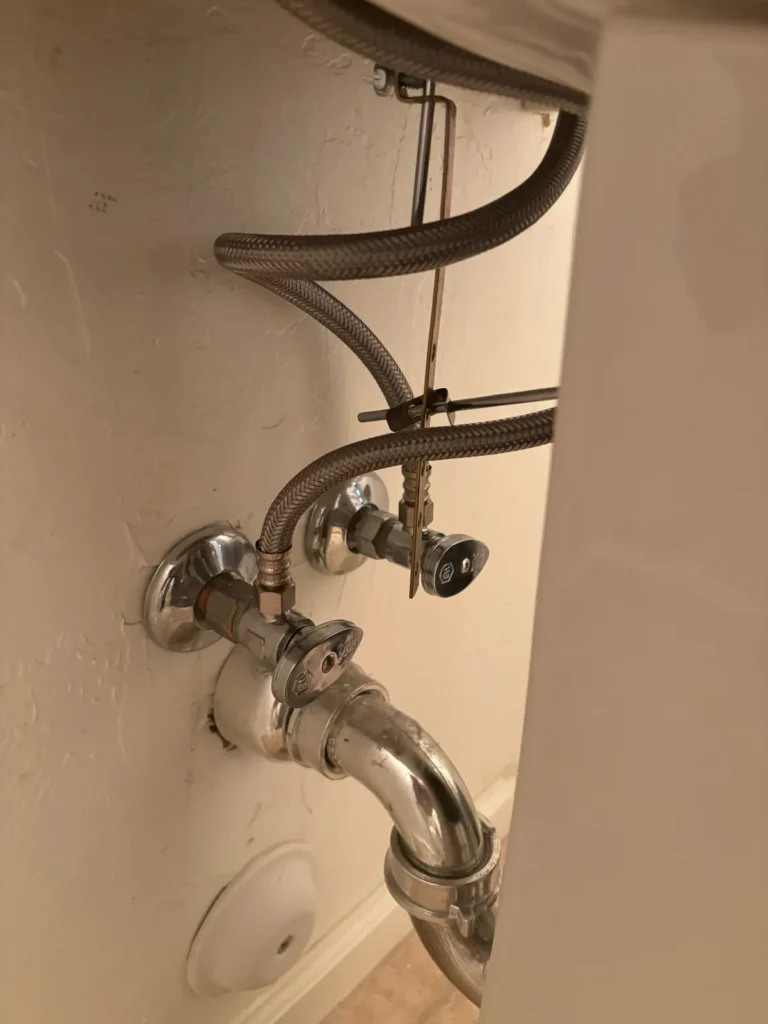
Even when the stop is fine, look hard at the line above it. Replace any supply line with a kink, a bulge, rusty or frayed braid, or a cracked plastic nut.
What a handy homeowner can take on
If your pipes are copper and the old stop uses a compression nut, replacing it is a fair DIY job. First, shut off the main water and open a faucet to drain the lines. Under a kitchen sink, also cut power to the garbage disposal at its plug or breaker, and leave any wiring alone. The old brass sleeve often stays stuck on the pipe, so you may need a sleeve puller. Then follow the valve maker’s instructions to fit the new stop.
Take the old stop and supply line to the store so the new parts match. Most stops take a 3/8 inch compression line, but the faucet or toilet end varies. Tighten each nut as the maker directs, because overtightening can distort the sleeve or crack the nut. Afterward, turn the water back on slowly and check for drips over the next day.
When to hand it off
- The pipe coming out of the wall is threaded steel, or the old valve has a soldered joint.
- Very little pipe sticks out, or it looks corroded where it meets the wall.
- Your main shut-off doesn’t close fully, so you can’t get the water off safely.
Geo replaces stops and supply lines as part of our faucet, toilet and fixture work. This bathroom job sits alongside others on our work page.
Angle stop questions we hear often
Should I replace every angle stop in the house at once?
Not necessarily. Test them all, then replace the ones that fail. That said, if several are the same age and two have already failed, doing the rest in one visit saves shutting off the main again later.
Is a quarter-turn angle stop valve worth the upgrade?
For most homes, yes, when you’re replacing a stop anyway. Even so, keep testing it along with the others, because hard water still builds up inside.
A five-minute habit worth keeping
Angle stops hide behind cabinet doors, yet they’re the quickest way to stop a leaking supply line. So the next time you clean under a sink, grab a flashlight and test each one. If any won’t turn, won’t close or keep dripping, you can set up a visit online. Geo will sort out which ones truly need replacing and which only need a turn now and then.