
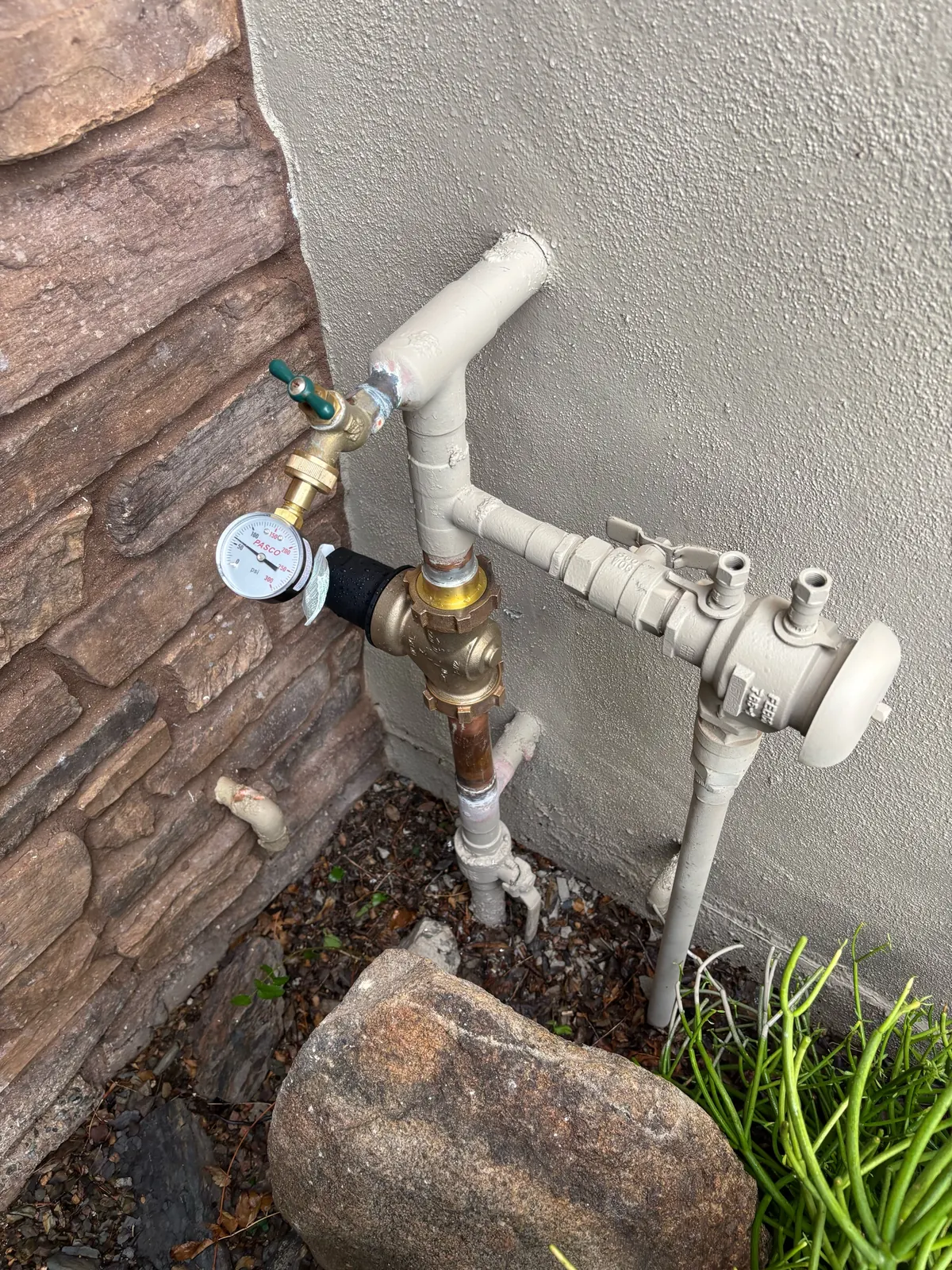
Banging pipes, a toilet that hisses all night, or a dripping relief valve on your water heater can all point to one small part. In many Phoenix homes, a water pressure regulator sits on the main line near the front hose bib. When it wears out, you can feel it all over the house.
Below, you’ll learn what it does, what the code allows, how to test it yourself, and when to leave it alone.
What a water pressure regulator does
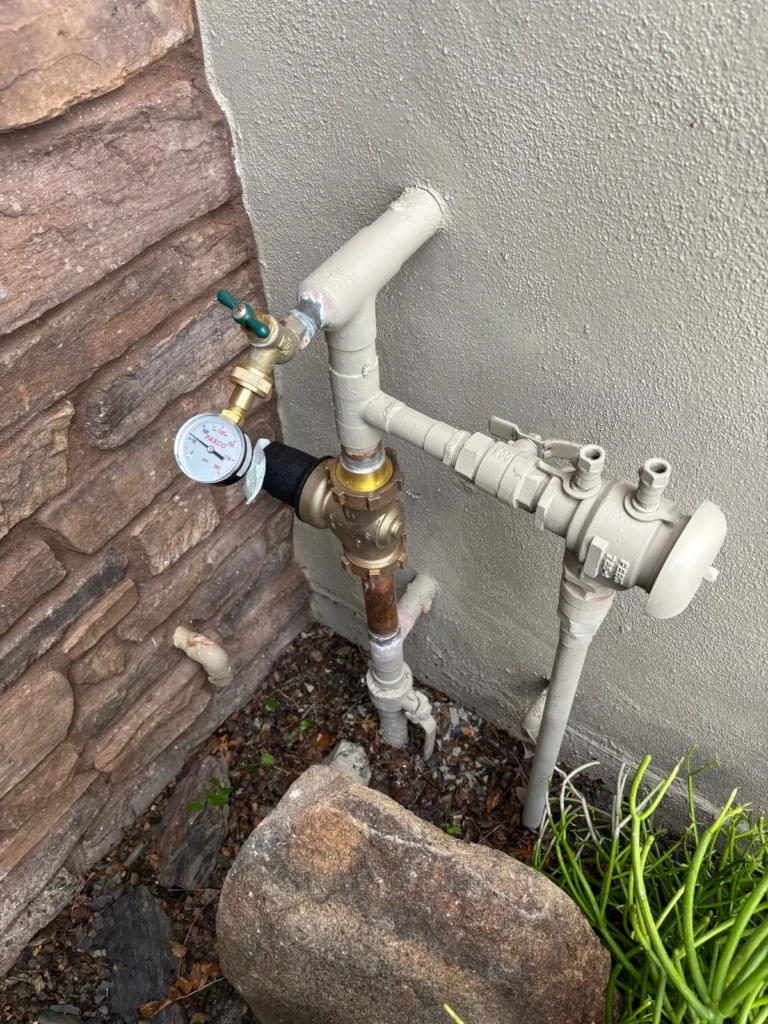
City water travels under strong pressure so it can reach every home on the system, including homes on higher ground. A regulator, also called a pressure reducing valve or PRV, lowers that supply to a steady level for your home.
Inside the brass bell, a spring presses on a rubber diaphragm. As you use water, the two open and close a small valve, so the pressure stays near its set point. Many models also have an adjusting screw on top and a screen that catches grit.
Ownership matters too. The City of Phoenix takes care of the line from the street to the meter, and you own everything from the meter to the house. In fact, the city requires a pressure regulator on your side of the meter and makes upkeep your job, according to its page on water pressure and service issues.
The 80 psi limit versus city water pressure
Here’s the part that surprises people. Phoenix considers anywhere from 40 to 100 psi an acceptable range in its water system. But the top of that range sits well above what the plumbing code allows inside a home.
Section 608.2 of the 2024 Uniform Plumbing Code caps static pressure in a home at 80 psi. Static pressure is the reading when no water is running. If street pressure runs higher, the code calls for an approved regulator with a strainer. Phoenix’s building code, in effect since August 2025, includes this 2024 edition. Other Valley cities adopt their own codes, so your local building department has the final word.
Pressure also varies across the Valley. Scottsdale says its pressure ranges from 40 psi up to about 120 psi because of changes in elevation. The city began requiring regulators on new buildings in 1995. If a home built before then reads 80 psi or more on a regular basis, Scottsdale suggests adding one.
So why not enjoy the extra push? Past a point, higher pressure doesn’t make your shower much better. Instead, it can wear out fill valves, faucet cartridges, washer hoses and supply lines faster. As a result, a home with high pressure often has a steady run of small drips.
Signs your water pressure regulator is failing
Regulators wear out slowly, so the signs creep up on you. Watch for these:
- Banging or hammering in the walls when a faucet or the washer shuts off.
- Toilets that hiss, run, or refill on their own between flushes.
- Faucets and showerheads that start to drip, even after a new washer or cartridge.
- A water heater relief valve that drips or runs out its drain pipe.
- Pressure that swings from strong to weak, or drops low across the whole house.
- Water seeping from the regulator itself, or a hum or whistle when water runs.
Why do they fail? Over time, the diaphragm stiffens, the spring weakens and the valve seat wears down. Valley water is also hard, and scale or grit can keep the valve from sealing. Then street pressure slips right past it.
Still, low pressure doesn’t always mean the regulator is the problem. Phoenix lists other common causes: mineral buildup in old galvanized pipes, a water softener that needs service, a house valve that’s partly closed, and clogged aerator screens. So check the easy ones first, like rinsing the grit out of a weak faucet’s aerator. If the front hose bib has strong pressure but the faucets inside don’t, Scottsdale suggests bypassing the softener and checking again.
How to check your water pressure with a gauge
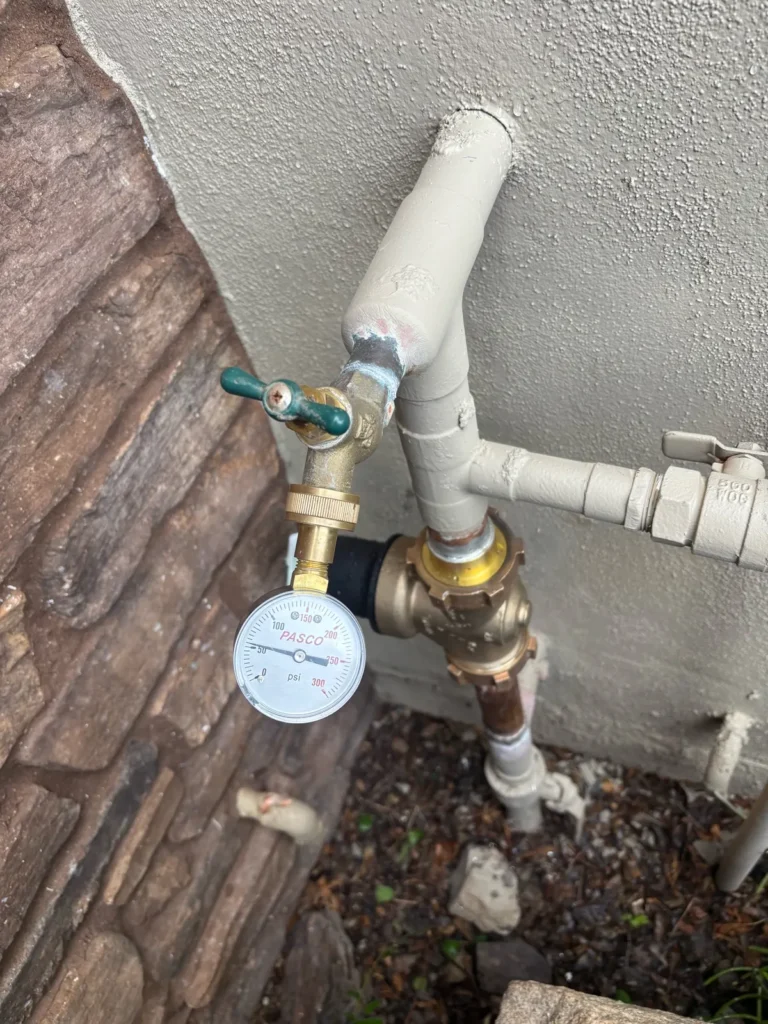
A pressure gauge with hose threads screws onto an outdoor faucet, and most hardware stores carry them. Pick one whose dial goes well past 100 psi, since some Valley systems run higher than that. A red max needle, which remembers the highest reading, is a handy extra. Scottsdale Water even lends gauges to its customers.
- First, stop all water use. Turn off the sprinklers and make sure the washer, dishwasher and softener aren’t running.
- Next, find the hose bib closest to the regulator, on the house side of it. In many Phoenix homes, it’s on the same pipe.
- Screw the gauge on by hand, then open the hose bib all the way.
- Read the needle. That number is your static pressure.
- Test again at another time of day. Phoenix notes that pressure can dip during the early morning rush.
- If your gauge has a max needle, leave it on for a full day. Then compare the highest reading to your normal one.
What your reading means
- Steady and under 80 psi, with good flow: you’re within the code limit. Leave it alone.
- Above 80 psi: the regulator may be set too high, failing, or missing.
- Normal by day but much higher on the max needle: this often points to thermal expansion from the water heater.
- Low reading or weak flow in every room: the regulator may be stuck, clogged or set low, or one of the causes above may be to blame.
Why you may also need an expansion tank
Water grows a little when it heats up. Without a regulator, that extra volume can push back toward the street. A regulator, however, acts a lot like a one-way door, so the expanded water has nowhere to go. As a result, pressure climbs each time a tank water heater runs, and the relief valve may start to drip.
That’s why the code pairs the two. Section 608.2 also calls for an expansion tank on the cold water line after each regulator, to keep pressure from rising past 80 psi. Section 608.3 adds one when a check valve or backflow preventer stops water from flowing back to the main.
Expansion tanks wear out too. Find the small tank on the cold line near the water heater and tap it with your knuckles. One side holds a cushion of air, so a healthy tank sounds hollow over much of its body. If it sounds dull and solid all over, it may be full of water and no longer doing its job.
Repair, replace or leave it alone
Some regulators can take a new cartridge or rebuild kit. Often, though, an older unit with a stuck screw or a worn body makes more sense to replace. Either way, the water has to be off for the work.
If a regulator ever starts spraying, close your main shut-off first. Our guide on how to shut off your water in a plumbing emergency shows where that valve usually sits, and what to do if you can’t find it.
Honestly, you may not need a new one. If your gauge reads steady and under 80 psi with none of the signs above, your regulator is doing its job. Just retest once or twice a year. That said, if your pressure looks fine but your water bill keeps rising, a hidden leak may be to blame. Our leak detection service can help track it down.
Curious what a swap looks like? You can see this exact regulator job, before and after, on our real project photos page.
Quick answers about your water pressure regulator
What should my home’s water pressure be?
The plumbing code caps it at 80 psi with no water running. Peoria’s water department, for instance, calls 50 to 80 psi normal. If your reading stays steady in that range and your fixtures work well, there’s usually no reason to change it.
How long does a regulator last?
There’s no set number of years. It depends on your water, your street pressure and the model. Instead of going by age, go by your gauge and the signs above.
Can I adjust my water pressure myself?
Sometimes. Most regulators have a screw and lock nut on top, and turning the screw clockwise usually raises the pressure. Make small changes, stay under 80 psi, and recheck the gauge each time. But if the screw won’t turn or the setting won’t hold, stop there, because forcing it can damage an old regulator.
Get a straight answer on your pressure
If your gauge reads high or your pipes bang, Geo can test the pressure, check the expansion tank and explain what he finds. After more than 12 years of hands-on plumbing, he’d rather tell you to keep a good regulator than sell you one you don’t need.
Read more about our everyday plumbing repairs. When you want a second set of eyes on that gauge reading, book a visit online.